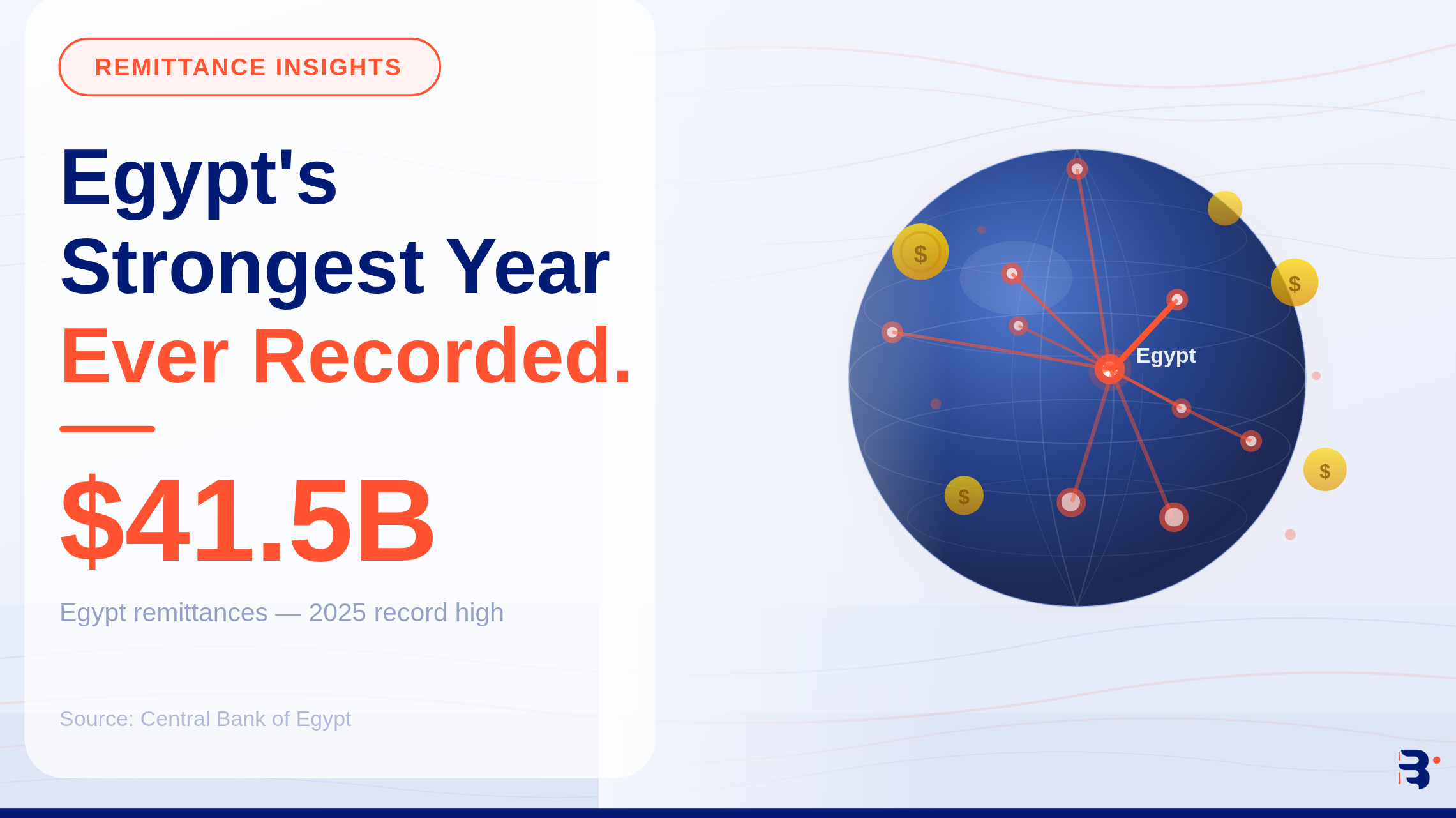
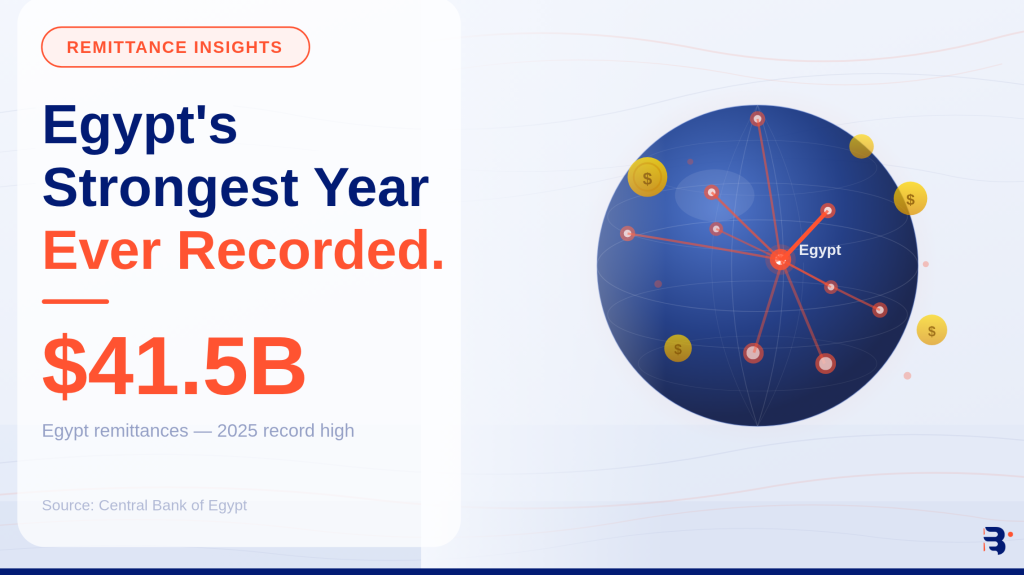
Egypt just recorded its strongest remittance year in history. According to the Central Bank of Egypt, remittances from Egyptians working abroad reached $41.5 billion in 2025, a 40.5% increase over the $29.6 billion recorded in 2024.
For most publications, this is a headline and a chart. For institutions running Egypt corridors, it’s an operational signal that demands a closer look.
This article breaks down what the numbers mean for MTOs, fintechs, and banks, not from a macro-economic perspective, but from an infrastructure and operations one.
The Numbers in Context
The $41.5B figure doesn’t tell the full story on its own. The pattern behind the numbers matters more.
Full-year 2025: $41.5B (+40.5% YoY vs. $29.6B in 2024)
H1 FY2025/26 (July–December 2025): $22.1B (+29.6% YoY)
December 2025 alone: $4.0B, the highest single month ever recorded in Egypt’s remittance history
January 2026: $3.5B (+21% YoY), confirming the momentum isn’t seasonal
Three things are driving this:
1. Exchange rate stabilization. Following Egypt’s managed float in March 2024, the gap between official and parallel exchange rates narrowed significantly. This brought remittances back through formal channels that had migrated to the grey market.
2. Diaspora confidence. Egyptian communities in the GCC, UK, USA, and Europe responded to improved economic signals by increasing the frequency and size of transfers.
3. Digital channel growth. Mobile-first remittance platforms captured new senders who previously relied on cash agents. Higher digital adoption means more transactions processed through API-connected infrastructure, including Balad’s.
What this creates for institutions running Egypt corridors is not just an opportunity. It’s operational demand at a scale many corridors weren’t designed for.
What High Volume Means Operationally
Volume growth in a remittance corridor doesn’t scale linearly. When transaction counts double, the operational complexity tends to more than double because edge cases, exceptions, and timing sensitivities compound.
Here’s what that looks like in practice on the Egypt corridor:
IPN Load and Status Lag
Egypt’s Instant Payment Network (IPN) is the backbone of local payout delivery. It’s fast when functioning well. But when volume spikes during Eid windows, month-end, or following a news event that triggers a rush of transfers, the delta between when a transaction completes and when that completion is reflected in status updates widens.
For institutions polling IPN status at 15-minute intervals, a completed transfer can look “stuck” for up to 14 minutes. Multiply that across thousands of transactions during a peak window, and you have a support ticket flood that has nothing to do with actual failures.
At Balad, we reduced IPN polling from 15 minutes to 3 minutes, a 5× improvement in status update frequency. The operational result: fewer “where is my transfer?” escalations during the periods when volume is highest.
Compliance Throughput
Higher volume means more cases hitting AML and sanctions screening queues. If your compliance tooling isn’t built to handle throughput efficiently with fast investigation, clear case routing, and explainable flagging, backlogs build up exactly when you can least afford them.
The institutions that struggle most during volume spikes are those running opaque, black-box screening where investigators can’t quickly understand why a case was flagged. Explainable screening, where the reason for a flag is visible and auditable reduces investigation time and clears queues faster.
At Balad, workflow and UI improvements have reduced average time per compliance case by approximately 3 minutes. Compounded across thousands of cases during a high-volume month, this is significant.
Reconciliation Under Pressure
Month-end reconciliation in a high-volume corridor is already complex. When volume is growing at 40%+ YoY, last year’s manual reconciliation process breaks under this year’s transaction count.
The institutions most exposed are those still relying on emailed reconciliation files, manual matching, or batch settlement processes that weren’t designed for real-time IPN flows. A $4B December creates a reconciliation challenge in January that can overwhelm ops teams.
3 Things Institutions Should Prepare for as Volume Scales in 2026
The trajectory is clear: Egypt’s remittance inflows will continue growing in 2026. The $25.6B recorded in just the first seven months of FY2025/26 (July 2025–January 2026) is already running 28.4% ahead of the same period last year.
Here’s what that means practically for institutions on the corridor:
1. Audit your status synchronization frequency. If you’re polling IPN at intervals longer than 5 minutes, you’re creating a visible reliability gap for your partners and end customers during every volume spike. The fix is technical and achievable, but it needs to happen before the next Eid window, not during it.
2. Stress-test your compliance queue capacity. Run a scenario: what happens to your investigation queue if transaction volume doubles over a 72-hour Eid window? If the answer is “backlogs we’d manually clear over several days,” that’s a staffing and tooling gap that volume growth will expose.
3. Move reconciliation from reactive to automated. On-demand reconciliation files are available whenever your ops or finance team needs them, not just at month-end, and change how exceptions get handled. The institutions that will scale on the Egypt corridor in 2026 are the ones that can close their books faster, not just process more transactions.
What This Means for New Entrants
For MTOs and fintechs considering the Egypt corridor in 2026: the data makes the commercial case clear. A $41.5B market growing at 40%+ YoY with momentum confirmed into early 2026 is not a market to wait on.
But entry timing matters operationally. Launching a corridor during a volume trough is very different from launching during a growth surge. The infrastructure you put in place in Q1 2026 will be stress-tested by the Eid Al Adha window later in the year.
The institutions that enter Egypt with a 2-week go-live and minimal infrastructure overhead — using existing, proven IPN connectivity and compliance tooling will absorb that stress better than those building from scratch.
Conclusion
Egypt’s $41.5B in 2025 isn’t just a macro milestone. It’s a leading indicator of what the corridor will demand from the institutions running it in 2026.
Higher volume means faster status requirements, greater compliance throughput, and more complex reconciliation compounding at scale. The institutions that prepare for this operationally, rather than reacting to it, will be better positioned to capture the corridor’s continued growth.
Balad provides payout infrastructure for international institutions operating in Egypt corridors. Our platform reduces IPN polling from 15 minutes to 3 minutes, delivers explainable compliance screening, and enables go-live in 2–6 weeks.